Insurance and Safety for Rubbish Clearance Wembley
 Rubbish Clearance Wembley teams operate in busy urban environments and our approach to safety and insurance is designed to protect clients, the public and our operatives. This page outlines how our waste clearance Wembley services manage risk, the public liability insurance we maintain, the training our staff receive, mandatory personal protective equipment and the structured risk assessment process we follow. We believe a well-documented and consistently applied safety system is essential for reliable clearance services in Wembley and surrounding areas.
Public liability insurance is a cornerstone of professional rubbish removal Wembley operations. Our insurance policies are underwritten to cover accidental injury to third parties and damage to property that could arise during clearance activities. Coverage limits and policy terms are reviewed regularly to ensure they meet the scale of our work: site clearances, domestic rubbish removal and commercial waste collection. Maintaining adequate cover is not just a legal formality; it provides peace of mind to homeowners, landlords and businesses that engage our clearance services Wembley-wide.

Public Liability and Insurance Details
Key aspects of our public liability protection include:- Comprehensive third-party coverage for bodily injury and property damage.
- Appropriate indemnity limits for both small and large-scale clearances.
- Regular insurance reviews to adapt to new types of work and regulatory changes.
Staff Training and Competence
Staff competence is essential for safe rubbish clearance in Wembley. Our operatives undergo structured induction training covering safe lifting techniques, manual handling regulations, traffic awareness when working near roads, and safe use of hand tools and powered equipment. Training modules include both classroom-style briefings and on-the-job mentoring to ensure practical skills are demonstrated under supervision. Records of all training, qualifications and refresher courses are maintained centrally so competency can be verified at any time.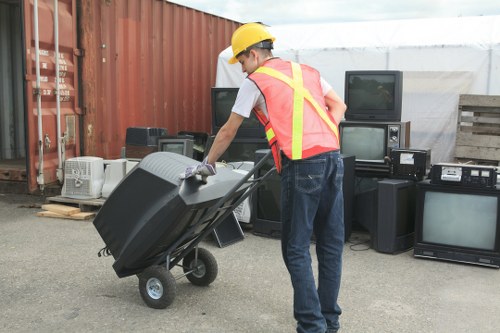 Training extends to specialist areas such as asbestos awareness (where applicable), hazardous waste handling and confined space basics for properties with restricted access. We deliver periodic toolbox talks and scenario-based drills to reinforce safe behaviours. Continuous professional development is encouraged: staff are supported to undertake industry-recognised courses and obtain certifications relevant to waste management and site safety.
Personal Protective Equipment (PPE)
The correct PPE is issued and enforced for all rubbish removal Wembley assignments. Our PPE policy is simple: provide appropriate equipment, ensure it fits, and require staff to use it consistently. Standard PPE items include:- High-visibility clothing for work near roads and in low-light conditions.
- Gloves suitable for manual handling of general and sharp waste.
- Safety boots with reinforced toes and slip-resistant soles.
- Protective eyewear and dust masks where airborne dust or debris are present.
- Specialist respiratory protection for tasks involving potential hazardous materials.
Risk Assessment Process
Our risk assessment process for rubbish removal in Wembley follows a staged methodology designed to identify hazards, evaluate risks and implement controls. Every job begins with a pre-start assessment: supervisors walk the site, identify access points, note obstructions, potential trip and fall hazards and assess vehicle positioning. This initial survey feeds into a written Risk Assessment and Method Statement (RAMS) tailored to the specific clearance activity.RAMS documents cover task sequencing, control measures, emergency procedures and responsibilities. They are shared with crews before work starts and reviewed if conditions change. We employ both planned and dynamic risk assessment techniques — planned RAMS for predictable hazards and dynamic on-site reassessments to manage unforeseen developments, such as unstable materials or weather-related hazards, during a clearance project.
For complex clearances, including those involving mixed commercial waste or potential hazardous items, our risk assessment process integrates COSHH considerations, segregation protocols and arrangements for licensed disposal. The process also defines vehicle risk controls — safe loading practices, securing loads and ensuring drivers comply with road safety and vehicle weight limits.
Auditing and monitoring are critical to maintain high standards across our Wembley clearance services. Regular safety audits, escorted by senior operatives and safety officers, verify compliance with RAMS and PPE usage. Incident reporting procedures are straightforward and non-punitive: any near miss, injury or damage is recorded, investigated and followed by corrective actions to prevent recurrence. Insurance renewals are aligned with audit outcomes to ensure cover reflects actual operational risks.
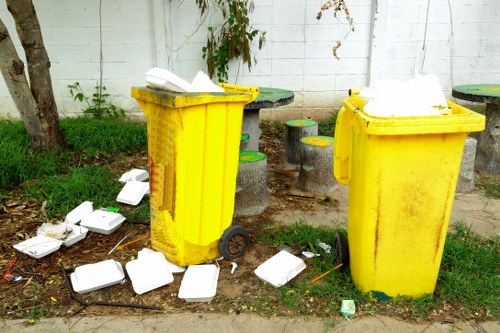 Emergency preparedness forms part of our duty of care: crews are trained in first aid, spill response and fire safety. Vehicles carry first aid kits, spill kits and fire extinguishers where appropriate. Clear lines of communication are maintained so that in the event of an incident there is an immediate, organised response and swift access to additional resources if required.